You can have a great coaching offer, a strong message, and years of experience behind you. But if the first few seconds of your video don't give people a reason to keep watching, they may never hear any of it.
That's the challenge with video ads for coaches. You're not just selling a product that can be explained with a list of features. You're selling your expertise, your approach, and ultimately the idea that you understand the problem your audience is trying to solve.
So what should you say in those first three seconds?
The answer isn't necessarily a louder voice, a dramatic transition, or a clever editing trick. A strong coaching ad usually starts by making the right person feel recognised.
Once you have their attention, you can do the more important work: show them that you understand their situation and have something useful to say.
Why the First 3 Seconds Matter in Coaching Ads
People don't usually open social media looking for another advertisement. They're scrolling through content, looking for something useful, interesting, entertaining, or relevant.
Your coaching ad has to earn its place in that feed.
That doesn't mean you need to manufacture urgency or make an exaggerated promise. Your opening needs to quickly answer the viewer's unspoken question:
“Why should I pay attention to this?”
For a coach, the answer comes from relevance.
A business coach might open with:
“You don't need more leads. You may need to fix what happens after the lead arrives.”
A career coach could say:
“If you're applying for jobs but getting no interviews, look at this first.”
A life coach might ask:
“What if feeling stuck isn't actually a motivation problem?”
Each opening creates a reason to continue.
Compare that with:
“Hi, I'm James, and I've been a coach for 12 years…”
The second opening may contain useful information, but it asks the viewer to care about the coach before giving them a reason to do so.
Your expertise still matters. It just doesn't need to be the first thing you say.
What Makes a Good 3-Second Hook?
There is no universal formula for every coaching business. Your hook should reflect your audience, your offer, and the problem you understand particularly well.
But strong hooks tend to do one of five things.
Start With a Problem
Call out something your ideal client recognises immediately.
For example:
“Still spending hours creating content that brings you no clients?”
This works because the viewer can quickly decide whether the statement applies to them.
Ask a Specific Question
Questions can make people pause because they naturally encourage an internal response.
Instead of:
“Do you want to improve your business?”
Try:
“Why are your sales calls going well until the moment you mention price?”
The second question gives the viewer something specific to think about.
Challenge an Assumption
If you have a strong point of view, use it.
For example:
“Posting more content isn't always the answer to getting more coaching clients.”
Now the viewer has a reason to find out what you believe the answer is.
Lead With a Desired Outcome
You can also start with what the viewer wants.
For example:
“Want your next webinar to turn more viewers into conversations?”
Keep the promise realistic and connected to what your coaching offer actually provides.
Make the Viewer Feel Seen
Some of the strongest hooks are simply observations that describe the viewer's situation accurately.
For example:
“You know exactly what you want to teach, but the moment the camera turns on, you forget how to say it.”
That's particularly relevant to coaches and speakers who know their subject but struggle with being natural on camera.
10 Hook Examples for Different Coaching Niches
The same hook doesn't work for every audience. Here are some examples you can adapt.
Business Coach
“Your business may not need more leads. It may need a better conversion process.”
This challenges the assumption that lead generation is always the biggest problem.
Life Coach
“If everything looks fine on paper but you still feel stuck, this is worth hearing.”
The opening targets an emotional situation rather than a technical problem.
Career Coach
“Sending CV after CV and still hearing nothing back?”
It immediately identifies a familiar frustration.
Fitness Coach
“If you're training consistently but your progress has stopped, don't just train harder.”
The statement creates curiosity around what the viewer should do differently.
Leadership Coach
“If your team needs you for every decision, this might be the real problem.”
The hook speaks directly to a leadership challenge.
Sales Coach
“If prospects keep saying ‘I'll think about it,’ listen to what you're saying before they do.”
This connects a familiar objection to the coach's area of expertise.
Mindset Coach
“You might not have a motivation problem.”
The short statement creates an information gap that the rest of the video can address.
Relationship Coach
“If every argument with your partner ends the same way, look at the pattern, not just the argument.”
This creates relevance without making an unrealistic promise.
Executive Coach
“Being the person with all the answers can make your team less capable.”
A challenging statement can be effective when the coach has a clear explanation behind it.
Course Creator
“Your course doesn't need more information. It may need a clearer transformation.”
This can open a conversation about positioning and communication.
The goal isn't to copy these lines word for word. Take the structure and replace it with something that genuinely reflects what your audience experiences.
How to Write Your Own Coaching Ad Hook
A good hook usually starts before you turn on the camera.
The easiest way to create one is to work through a simple process.
Step 1: Know Who You Are Talking To
Don't begin by asking, “What should I say?”
Start with:
“Who needs to hear this?”
A business coach talking to startup founders will use different language from an executive coach talking to senior managers.
The more clearly you define the audience, the easier it becomes to identify the right problem.
Step 2: Pick One Problem
Don't try to explain your entire coaching programme in the first few seconds.
Choose one problem.
For example, a business coach may help clients with positioning, sales, hiring, systems, leadership, and marketing.
One advertisement doesn't need to address all six.
Choose the issue that's most relevant to the specific audience you want the video to attract.
Step 3: Find the Tension
Ask yourself:
What's frustrating this person?
What have they already tried?
What do they believe is causing the problem?
What might actually be causing it?
What question do they keep asking?
The answers can become your hooks.
Step 4: Say It Like a Human
This is where many coaching ads go wrong.
A sentence may look excellent on paper but sound unnatural when spoken.
If you'd never say something to another person in a normal conversation, rewrite it.
Instead of:
“Our transformational methodology facilitates enhanced entrepreneurial performance…”
Say:
“You're working hard. The problem might be what you're working on.”
Simple usually sounds better on camera.
Step 5: Give the Hook Somewhere to Go
A hook isn't the entire advertisement.
If you open with:
“You don't have a motivation problem.”
The next sentence needs to explain why.
For example:
“You don't have a motivation problem. You have five different priorities competing for your attention.”
Now the hook has created a conversation.
That conversation can lead into your insight, framework, experience, or offer.
Your Hook Is More Than Words
A good opening isn't only about the sentence you say.
Your delivery matters.
Your framing matters.
The visual matters.
And the way the video is edited matters.
For example, a talking-head video can work well when the coach looks comfortable and speaks directly to the viewer. But if the same person is reading a long script word-for-word, the result can feel stiff.
The production process matters as much as the initial idea.
The aim shouldn't be to turn a coach into an actor. It should be to help the coach communicate what they already know clearly.
Why Natural Delivery Matters in Coaching Ads
Coaches spend their professional lives talking to people. Yet many become uncomfortable when a camera appears.
Suddenly, they're thinking about where to look, whether they said the sentence correctly, what their hands are doing, and whether they sound professional enough.
The result is a version of themselves that sounds less natural than they do in an actual conversation.
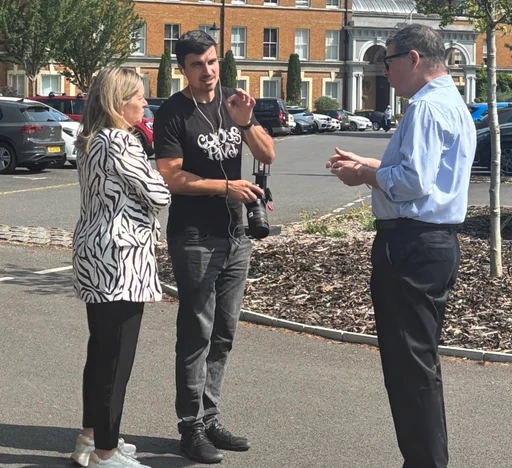
I take a different approach.
My process starts with the coach's existing knowledge. That might be notes, a presentation deck, or even a voice note. I shape the material into a script that's broken into manageable sections rather than one large script that needs to be memorised.
The filming approach is designed around conversation rather than performance. I guide the speaker, ask the right questions, and help capture the useful answers.
That matters because a coaching advertisement should still sound like the coach.
The goal is to make the coach sound like themselves on their best day.
Here's what that looks like in practice. One client arrived for a shoot and told me he was always tense in front of the camera. I gave him direction and a few simple techniques, and over the session he settled down and became comfortable. At the end, he watched the ad back and said I'd made him look the best he possibly could.
A Simple Structure for a Coaching Video Ad
Once your opening has earned attention, you need to keep the viewer engaged.
A useful structure is:
Hook → Problem → Insight → Proof → CTA
Hook
Give the viewer a reason to listen.
Problem
Show that you understand what they're dealing with.
Insight
Teach them something useful or give them a new way to think about the problem.
Proof
Demonstrate relevant experience, examples, case studies, or genuine client feedback.
Proof matters because it's one thing to explain that an approach works and another to show what happened when you used it.
For example, I worked with a coach who was struggling to get people onto her landing page. We spent about four hours on a single ad, working through multiple setups and properly polishing the piece rather than rushing through it. After the ad went live, her landing page visits tripled.
How Video Marketing for Coaches Goes Beyond Paid Ads
Video marketing for coaches doesn't have to mean creating one advertisement and putting it behind a paid campaign.
The same core ideas can be turned into a wider content system.
For example, one coaching topic could become:
A short paid advertisement
An organic social media reel
A longer educational video
A webinar clip
A sales-page video
A client-focused FAQ
Several short-form content pieces
This is particularly useful for coaches who already have a large amount of knowledge but struggle to turn that knowledge into consistent content.
Your existing material can become the starting point.
You may already have:
Workshop notes
Presentation decks
Voice notes
Webinar recordings
Existing footage
Course material
Frequently asked questions
Instead of starting from a blank page every time, you can build content around what you already teach.
My process lets you start with rough material such as notes, decks, or voice notes and turn that material into scripted, filmed, edited content.
Why the First Few Takes Usually Don't Make the Final Cut
The first few takes almost never get used. People are still warming up, getting comfortable with the camera, and finding their rhythm.
That's normal.
It's also why a longer, unhurried solo session beats a rushed shoot with a crew standing around. There's room to settle in, try different versions, make mistakes, and warm up without pressure.
The goal isn't to get the perfect take immediately. It's to create the space for the best take to happen.
Common Mistakes to Avoid
Starting With Your Biography
Your experience matters, but it doesn't have to be the opening.
Lead with the viewer's problem before explaining your background.
Trying to Say Everything
One video can't explain your entire coaching philosophy.
Give each video one clear purpose.
Writing a Huge Script
A long script can make filming feel like a performance.
Break the message into smaller, conversational sections.
Sounding Like an Advertisement
If every sentence sounds polished to the point of being unnatural, viewers may disconnect.
Aim for clarity, not corporate language.
Making Big Promises
Avoid claims such as guaranteed income, guaranteed clients, instant transformations, or effortless results.
A credible coaching brand doesn't need exaggerated promises.
Focusing Only on Production
Good cameras and editing can improve presentation, but they can't fix unclear messaging.
The idea comes first.
Using Only One Hook
Your first idea isn't automatically your strongest idea.
Write several openings and consider which one speaks most directly to the audience you want.
Forgetting the Next Step
A viewer who stays until the end should know what to do next.
Whether that means learning more, starting a conversation, visiting a landing page, or exploring your offer, make the next step obvious.
When Professional Video Ads & Content Make Sense
You don't necessarily need a complicated production setup to communicate a good idea.
But there's a difference between knowing what you want to teach and turning that knowledge into a piece of content that works on camera.
If you're a coach or speaker with something to launch — a programme, course, offer, masterclass, or lead magnet — professional production can take some of that work off your plate.
I focus specifically on Video Ads & Content for coaches, speakers, course creators, and educators. The service covers scripting, direction, filming, and editing, with the finished content prepared for use across platforms.
The process starts with what you already know rather than expecting you to become a professional scriptwriter.
You provide the thinking.
The production process helps turn that thinking into something clear, useful, and easy to say.
For coaches who dislike being on camera, that distinction is especially important.
You don't need to become someone else for the camera.
You need a process that helps you communicate naturally.
What Should You Look for When Choosing a Video Production Partner?
If you're considering professional help with your coaching advertisements, don't only compare cameras, locations, or editing packages.
Look at the process.
Ask:
Do They Understand Your Audience?
A video producer should understand what the content is trying to achieve, not just how to film it.
Can They Help With the Message?
If you have expertise but struggle to turn it into a concise script, look for someone who can help shape the material.
Will You Have to Memorise Everything?
For many coaches, this is one of the biggest concerns.
A process based around smaller sections and guided conversation makes filming considerably more comfortable.
Can They Create Multiple Pieces?
A productive shoot doesn't need to produce one video.
Content can be planned in batches so that one shoot supports multiple pieces of content.
I usually batch shoots into several pieces — often 5–15 in a day, depending on the project.
Are the Videos Ready to Use?
Consider whether the final content is properly edited, captioned, and prepared for the platforms where you intend to use it.
Testimonials
Andy Harrington — NY Times Best Selling Author
“I have been working with Pav for years and he also became a good friend of mine. That says a lot about the quality of the person he is.”
Lisa Phillips — Salon Owner
“He guides you, directs you, gives you ideas and advice. I didn’t need to memorise the whole script. Pav makes the whole process extremely easy.”
Dene Stuart — Business Coach
“Working with Pav has been an absolute delight, particularly when creating the adverts.”
Ruth Driscoll — Toxic Relationship Expert
“If you’re looking for somebody to help you with videos for your business, Pav is your man!”
People Also Ask
What should a coach say in the first 3 seconds of an ad?
Start with something directly relevant to the audience, such as a specific problem, question, desired outcome, or surprising insight. Avoid using the opening only to introduce yourself.
How long should a coaching video ad be?
There is no single perfect length. The video should be long enough to communicate its message and provide value without adding unnecessary information.
What makes a coaching ad effective?
A strong coaching ad is relevant to a specific audience, communicates a clear idea, feels credible, and gives the viewer a reason to take the next step.
How do I create video ads for life coaches?
Start with a specific problem or desired outcome experienced by the life coaching audience. Build the hook around that issue, then use the rest of the video to provide a useful insight and explain the next step.
Do I need to be good on camera to create coaching ads?
No. Being comfortable on camera helps, but a good directing process makes filming easier. Breaking content into smaller sections and using conversation rather than memorisation helps coaches sound more natural.
Conclusion
The first three seconds of your coaching ad don't need to be complicated.
They need to be relevant.
Start with the problem your audience recognises. Ask a question they genuinely want answered. Challenge an assumption. Or give them a reason to believe that the next few seconds will be useful.
Then keep the rest of the video focused.
For coaches, the biggest challenge isn't knowing what to say. You already have the knowledge. The challenge is turning that knowledge into something clear, natural, and watchable on camera.
That's where the right production process helps.
Create With Pav works with coaches, speakers, course creators, and educators to turn existing knowledge into scripted, directed, filmed, and edited video content without expecting the person on camera to become an actor.
If you have something worth saying, the next step is making it easier to say and giving the right people a reason to listen.
Author Bio
I'm Pav. I make ads, content and videos for people who teach for a living — coaches, speakers, course creators and educators. I handle the scripting, direction, filming and editing, so you can sound natural on camera and turn ideas you already have into content that's ready to use.
Get in touch:
info@createwithpav.com
Tell me what you’re making or the event you’re running — I’ll take it from there.
Start a conversation